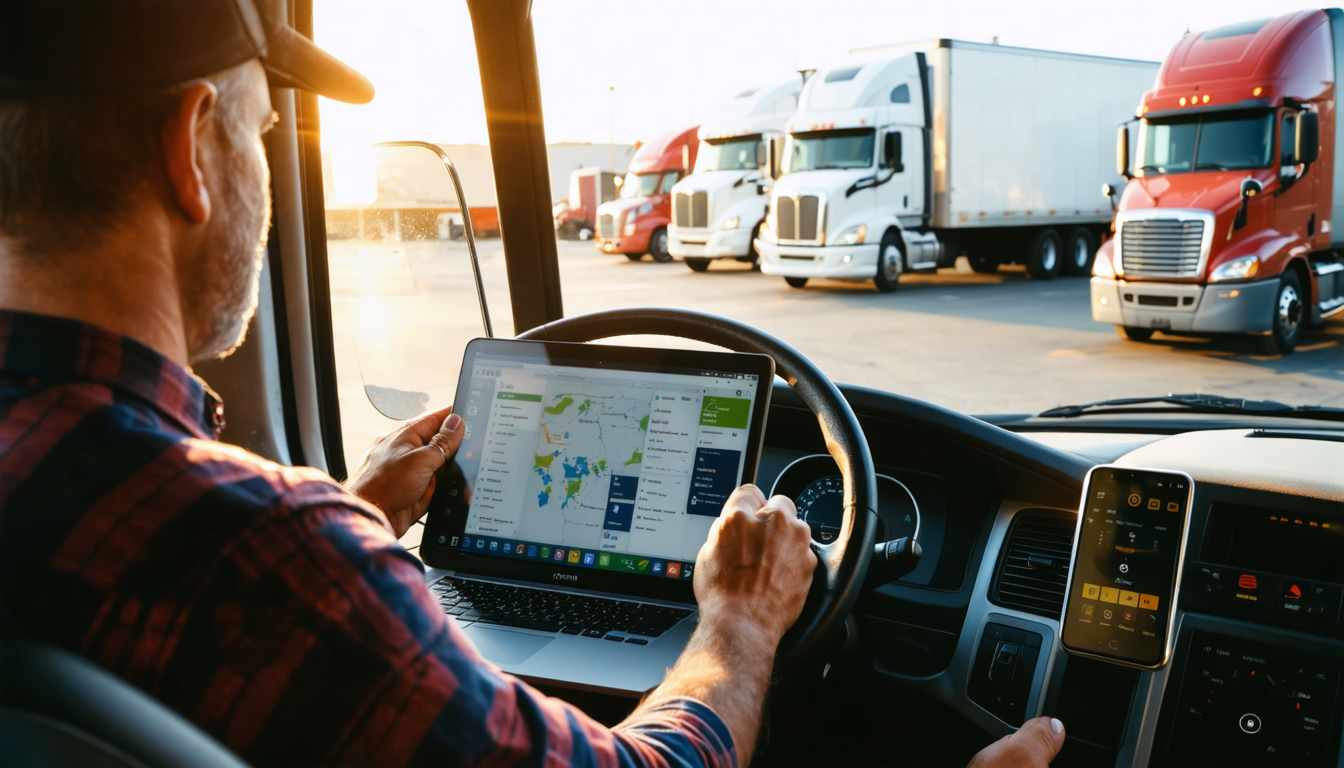
The freight market is running hot, compliance is tightening, and owner-operators who can move loads fast and clean are winning. But running a small fleet without the right systems—dispatch tools, load matching, compliance tracking, fuel optimization—means you're leaving money on the table and risking violations. The good news: you don't need enterprise software or a six-figure IT budget. A growing number of small fleet owners are mixing affordable off-the-shelf tools with custom automation to build a lean, competitive operation.
Why Small Fleets Need Systems Now
A year ago, a solo owner-op could survive on phone calls, a spreadsheet, and a CB radio. That's not true anymore. Brokers now demand real-time tracking and proof of compliance. Shippers want instant quote responses. FMCSA audits are up, and your ELD data is under scrutiny. Deadhead miles kill margins in a tight market. Without visibility into load profitability, fuel costs, and driver utilization, you can't compete with carriers who have it.
The catch: enterprise TMS (transportation management system) platforms cost $500–$2,000+ per month and require months to implement. For a 3–5 truck fleet, that's not viable. The answer is to build a lightweight stack: a loadboard (like Doft), an ELD, a basic accounting tool, and one or two automation layers that tie them together.
The Core Stack: Start Simple
Load Matching & Visibility. Use a loadboard (Doft, DAT, Convoy, or similar) as your primary load source. Good loadboards let you filter by rate, lane, and trailer type in seconds—no broker phone tag. Doft specifically offers instant matching and real-time tracking, which cuts the time between load acceptance and dispatch to minutes instead of hours. That speed compounds: you get more loads, less deadhead, and faster payment.
ELD & Compliance. You already have an ELD (it's federal law). Use it as your data source, not just a logbook. Most modern ELDs (Samsara, Verizon Connect, Geotab, Omnitracs) export data to CSV or API. That data tells you hours-of-service utilization, idle time, harsh braking events, and fuel economy per driver per lane. Don't ignore it.
Accounting & Fuel Tracking. A spreadsheet or QuickBooks Online works fine for invoicing and P&L. But add a fuel card with real-time reporting (Comdata, Speedway, Love's, or your fuel network). Track fuel cost per mile by lane and driver. This one metric—fuel efficiency—is often where small fleets leak profit without knowing it.
The Automation Layer: Where Small Fleets Win
This is where the economics shift. A few small fleet owners have started using no-code automation platforms (Zapier, Make, or simple Python scripts) to connect their loadboard, ELD, and accounting tools. Here's what that looks like in practice:
Automated Load Profitability. When a load books, the system pulls the rate, estimated fuel cost (based on distance and current diesel prices), and driver hours available. It calculates net margin and flags loads that don't meet your minimum threshold. You stop accepting $1.50/mile loads without thinking.
Dispatch Routing. Tools like Google Maps API or Routific can optimize multi-stop loads or find the shortest deadhead route to your next pickup. For a small fleet, this saves 50–200 miles per week per truck.
Compliance Alerts. Your ELD data feeds into a simple dashboard. If a driver is approaching HOS limits or hasn't passed an inspection in 12 months, you get a Slack or email alert. No surprises at a weigh station.
Fuel Optimization. Track fuel cost per gallon by stop, and flag stations where you're overpaying. Some small fleet owners use this to negotiate better rates with their fuel card provider or switch networks.
None of this requires hiring a software developer. Platforms like Zapier let you build these workflows with no code. If you're more technical, a junior developer can build a lightweight custom tool in a few weeks for $2,000–$5,000, then maintain it for $200–$500/month.
Real-World Example
A small fleet owner in Georgia with 4 trucks recently shared that after building a simple load-profitability dashboard (using Doft's API, his ELD data, and Zapier), he cut his average deadhead from 180 miles to 110 miles per cycle. At current rates (~$2.50/mile loaded, ~$0.50/mile deadhead), that's roughly $1,400/month in margin recovery across the fleet. The automation stack cost him $300/month in tools and 40 hours of setup. It paid for itself in one week.
What to Avoid
Don't over-engineer. A fancy dashboard that no one reads is waste. Start with one metric: load profitability or fuel cost per mile. Get that right, then add the next layer. Don't replace your ELD or loadboard with a custom tool—those are commodity services now, and the off-the-shelf versions are better. Use automation to connect them, not replace them.
Also, make sure your tools talk to each other. A loadboard that won't export data, an ELD that locks you in, or an accounting system that can't import fuel data will kill your automation plans. When you're evaluating tools, ask: "Can I get my data out in a standard format (CSV, JSON, API)?" If the answer is no, move on.
The Path Forward
The freight market's tightness is real, but it's also temporary. What lasts is operational efficiency. Small fleets that can move loads fast, stay compliant, and know their unit economics will survive the next downturn. You don't need a $2,000/month enterprise platform to do that. You need visibility, speed, and discipline—and a lightweight tech stack can give you all three.
Start with your loadboard and ELD. Add one automation. Measure the result. Then scale. That's how you compete.
Move freight smarter with Doft
Thousands of loads, instant matching, and fast carrier pay — all in one place.
Sign up free