
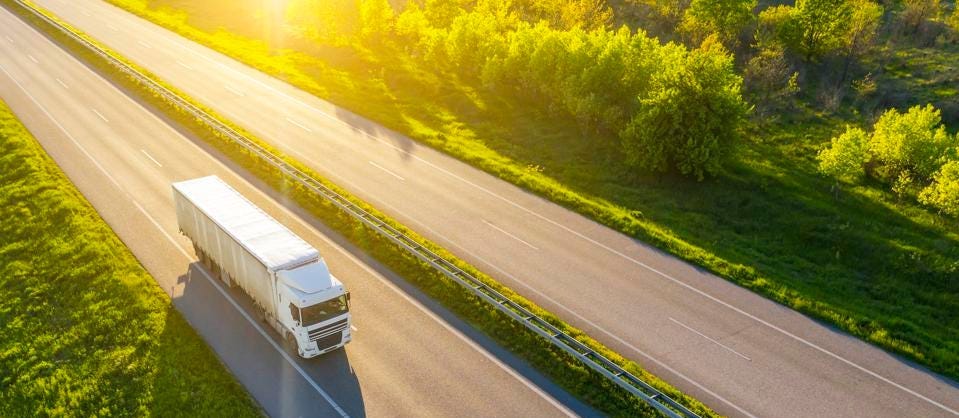
The climate challenge won't fix itself, but smarter logistics can help. Optimizing AI resources and processes to create less waste benefits both businesses and the planet's future, and the transportation sector is one of the biggest opportunities.
What's the Shipping Industry's Environmental Impact?
Shipment waste is where much of the pollution in the private commerce sector comes from, mostly carbon dioxide emissions. According to Environmental Protection Agency data, passenger and freight transportation were responsible for 28% of U.S. greenhouse gas emissions in 2018, the equivalent of 1,870 million metric tons of CO2. As freight demand increases, so do emissions.
Another byproduct of shipment waste is fuel and energy consumption. The less fuel trucks burn while delivering cargo, the lower the total emissions. To transport more efficiently with less pollution, companies can switch to cleaner vehicles or rethink the structure of a supply chain. Optimizing logistics at every stage yields significant results.
How AI Can Optimize Resources
AI in transportation involves much more than driverless vehicles. On a broader scale, AI can help solve problems related to safety, reliability, predictability, efficiency, and sustainability.
The number-one way AI cuts waste in trucking is by optimizing backhauls. Thirty-five percent of all miles are driven by unloaded trucks. An empty truck not performing its primary function is a complete waste of fuel. To find a return load, drivers traditionally search load boards or call multiple brokers, which burns time and effort in a business where profit hinges on efficiency.
Freight apps help drivers find and deliver backhauls. They let trucks book a return load the moment a delivery is reserved, or grab several orders to build a fuller return trip. By loading trucks efficiently and booking backhauls early in the journey, carriers cut empty miles and reduce CO2.
AI can also reduce emissions beyond the road. It can help optimize energy use, identify the factors that most impact demand, and immediately tune output. A large share of energy produced in the United States is "lost to the environment" as waste heat. AI can help isolate would-be wasted energy before it disappears, an approach already proven when major data-center operators used machine learning to cut excess heat production significantly.
How the Private Sector Can Pollute Less
To make real progress, every business can adopt a roadmap to reduce pollution and emissions over a three-, five-, and ten-year horizon, and stick to it. That can feel daunting for cost-conscious operations, but the long-term payoff is real.
Some challenges leaders may face when adopting AI include computing power and a trust deficit. Companies need adequate systems to run AI, and many in transportation are still catching up on technology compared with other industries. Because deep-learning models can be hard to interpret, teams new to AI may be slow to trust it at first.
Still, integrating AI into transportation creates real solutions for cutting pollution, and it tends to drive higher efficiency and a competitive edge. To move toward cleaner operations, companies should follow the latest technology and quality standards in their field at every stage of the business cycle.
Move freight smarter with Doft
Thousands of loads, instant matching, and fast carrier pay — all in one place.
Sign up free