
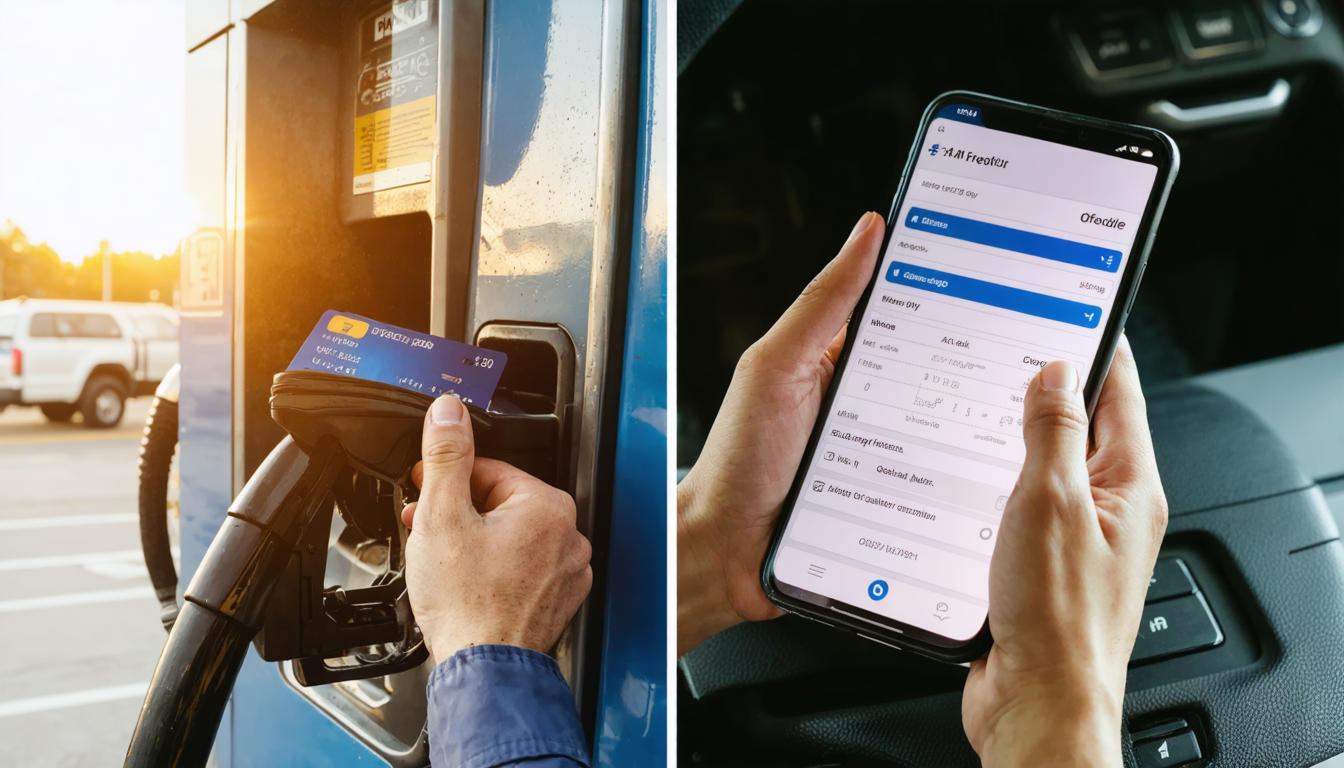
Owner-operators juggle cash flow like few other professionals. You buy fuel upfront, wait days or weeks for payment from brokers, and meanwhile your credit card bill is due. Two tools promise relief: fuel credit cards and factoring. But they solve different problems, and picking the wrong one can quietly drain your margin.
The headlines say fuel credit cards are trending (nav.com just published a 2026 guide), and factoring has been a staple for years. Both work—but they work differently, and the math matters.
Fuel Credit Cards: The Speed Play
A fuel credit card is straightforward: you swipe at the pump, and the issuer (Speedway, Pilot, Shell, or a trucking-specific provider) extends you a line of credit. You pay the bill monthly, usually with no interest if you pay in full.
Why owner-ops use them:
- Instant fuel access with no cash outlay.
- Rewards or rebates (typically 1–3% back on fuel).
- Builds personal credit history.
- No underwriting delays; approval can take days.
- No factor taking a cut of your freight revenue.
The catch:
- You still need working capital for everything else (truck payment, insurance, repairs, tolls).
- If you carry a balance, interest rates are often 18–24% APR—brutal on thin margins.
- Limits are usually capped at $10k–$25k, depending on your credit and the issuer.
- Doesn't solve the core cash-flow problem: waiting for freight payment.
Factoring: The Cash-Flow Accelerant
Factoring is different. You sell your freight invoice to a factor (a specialized lender) and get paid immediately—usually 85–95% of the invoice within 24 hours. The factor keeps the difference (the "factor fee") and waits for the shipper or broker to pay them.
Why owner-ops use it:
- You get paid today, not in 30 days.
- No credit check; approval is based on freight quality, not your credit score.
- Covers your whole cash-flow gap, not just fuel.
- Frees you to take loads without worrying about float.
The cost:
- Factor fees typically range from 1.5% to 3.5% of invoice value, depending on your credit quality and load consistency.
- On a $2,000 load, that's $30–$70 per invoice.
- If you factor 40 loads a month, you're paying $1,200–$2,800 monthly in fees.
- Some factors also charge per-transaction fees, fuel advances, or settlement fees.
The Real Math: Fuel Card vs. Factoring
Let's model a typical small-fleet owner-op running 40 loads per month at an average $2,000 gross per load:
Fuel Card Scenario:
- Monthly fuel spend: ~$4,000 (at current diesel prices, roughly 5–6 mpg over 40 loads).
- Fuel card rebate: 2% = $80/month saved.
- But you still wait 30 days for broker payment. If your cash buffer is thin, you may carry a balance on the fuel card at 20% APR.
- Carrying $5,000 for 15 days at 20% APR costs ~$41/month in interest.
- Net monthly cost: ~$40 (interest minus rebate).
- Annual: ~$480.
Factoring Scenario:
- 40 loads × $2,000 average = $80,000/month in invoices.
- Factor fee at 2.5% = $2,000/month.
- You get paid in 24 hours; zero working capital stress.
- Monthly cost: $2,000.
- Annual: $24,000.
On paper, the fuel card looks cheaper. But that math assumes you don't carry a balance and you do have enough cash float to wait 30 days. Most owner-ops don't.
When Fuel Cards Make Sense
- You have a solid cash reserve (6–8 weeks of operating expenses).
- Your brokers pay consistently and on time (15–20 day average).
- You can pay the fuel card balance in full every month.
- You want to build personal credit.
- You're running a steady, predictable lane or contract.
When Factoring Makes Sense
- You're running spot freight with variable payment terms (net 30, net 45, COD).
- Your cash buffer is thin or you're growing fast.
- You want to take loads without waiting for payment.
- Your brokers are reliable but slow (30+ days).
- You'd rather pay a percentage fee than carry interest-bearing debt.
The Hybrid Approach
Many successful owner-ops use both: a fuel card for daily pump stops (and the rebate), and a factoring line for spot loads or when cash gets tight. The fuel card stays at zero balance; the factor only gets used when you need it. This minimizes fees while keeping maximum flexibility.
A Word on Doft's Angle
If you're using Doft's loadboard to find and book spot freight, factoring becomes more valuable—because spot loads often come with longer payment terms than contract work. Faster payment from a factor means you can book more loads, more often, without cash-flow risk.
The Bottom Line
Fuel credit cards are a tool for managing pump costs and building credit. Factoring is a tool for managing cash flow. They're not competitors; they solve different problems. If you're carrying a fuel card balance every month, you're probably better off factoring. If you're waiting 30+ days for broker payment regularly, factoring almost always wins the math. Run the numbers for your own operation—your freight volume, average payment terms, and cash buffer—and pick the tool that fits your reality, not the marketing.
The owner-ops who stay profitable aren't the ones paying the most in fees; they're the ones who know which fee to pay.
Move freight smarter with Doft
Thousands of loads, instant matching, and fast carrier pay — all in one place.
Sign up free