
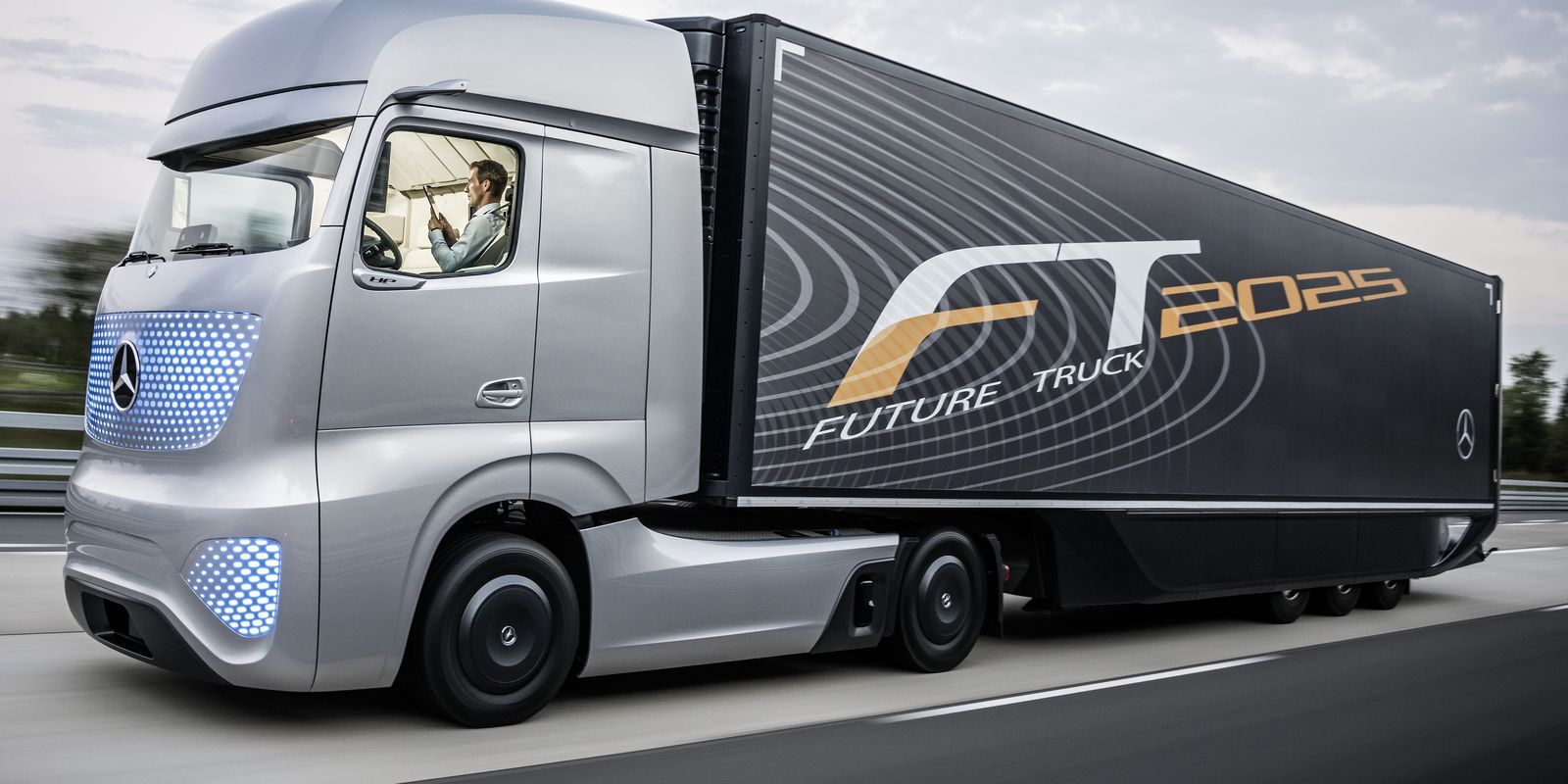
Autonomous technology will likely alter the way commercial vehicles are designed from the inside out. The changes could let drivers, who today have a single job behind the wheel, evolve into operators and managers who multitask while on the road.
Some automakers have already mapped out the future. Mercedes-Benz and Italian truck maker Iveco both released concept art hinting at how vehicles might change if no driver is required.
Mercedes-Benz's Future Truck concept demonstrates several potential benefits of vehicles designed for autonomous driving. When operating in a mode dubbed Highway Pilot, the vehicle drives independent of a driver. In this self-driving setting, occupants can turn their chairs away from the dashboard and focus on other tasks. The concept also features a conventional steering wheel plus an on-board tablet used for navigation and to monitor freight loaded on smart pallets.
Iveco introduced an autonomous concept known as the Z Truck. The vehicle uses a natural gas engine to reduce emissions, active and preventive safety systems to mitigate accidents, and platooning technology for improved safety and efficiency. Martin Flach, alternative fuels director for Iveco, said the external design is more rounded in shape, unlike "the brick wall" of virtually all commercial vehicles today.
A Mobile Office Behind the Wheel
Both trucks offer rotating seats designed to improve driver comfort and boost productivity. The self-driving trucks of tomorrow will likely include a mobile office that lets drivers handle other tasks while the vehicle is moving, said Bryan Flansburg, president of the NAFA Fleet Management Association.
"I envision that the co-pilot seat would be more of a mobile office," Flansburg said.
Plumbers and electricians, for example, could complete work orders while commuting so they are ready to go when they arrive on site. "While you're moving from that job to the next, you're back at a computer desk ordering parts, restocking, billing your customers — everything as you move down the road," he said. "My feeling is it's going to be an evolution."
Health, Connectivity, and Comfort
Autonomous technology could help reduce some of the pain points caused by long shifts. Health and wellness monitoring is expected to be an essential part of self-driving trucks, said Sandeep Kar, then global vice president of mobility for Frost & Sullivan. He envisioned systems that detect cabin air pollution and provide pollen alerts, seats that monitor blood pressure and stress, and steering wheels that detect a driver's pulse, oxygen saturation, and perspiration.
The mobile office will also need connectivity. "When you take away the requirement to operate the vehicle, then the driver is just sitting there," said Bob Williams, president of the National Conference of State Fleet Administrators. "They're going to fill that time with their mobile device, or they're going to be doing something for their job."
Easing the Driver Shortage
Autonomous trucks could also reduce the ongoing driver shortage. Instead of eliminating drivers altogether, the number required for some operations could shrink. "There are hours-of-service restrictions," Williams said. "A driver can only drive for so many hours a day by federal law, and then he has to rest." With autonomous tech, the truck could pick up the slack when a driver is fatigued, and any savings could be applied to compensation incentives to retain drivers.
Trucks with more comfortable interiors may also attract new drivers. Daimler's redesigned Freightliner Cascadia, for example, features improved door seals to reduce interior noise, more comfortable seats, and a redesigned living space — one configuration comes with a two-seat dinette, a Murphy-style bed, ambient LED lighting, and multiple power options.
But all those interior features could distract occupants. If driver intervention is required, alarm systems will redirect attention. These alerts are similar to advanced systems already on the market: camera- and radar-based packages that combine forward-collision warnings with active braking and can react to stationary vehicles.
Not Every Truck Will Change
Not all trucks are likely to evolve at the same pace, said Mario F. Guzman, a city fleet manager in West Palm Beach, Fla. He manages vocational fleets such as sanitation trucks, designed for one purpose. "With this kind of blue-collar work, it's a different animal altogether," he said.
Still, single-purpose vehicles such as dump trucks might benefit from an autonomous upgrade and an enhanced cab. Guzman even sees a future for autonomous ambulances, where extendable-cab concepts and flexible cargo space could free up crew to focus on patients rather than driving — potentially a game-changer for emergency response.
Source: Trucks.com
Move freight smarter with Doft
Thousands of loads, instant matching, and fast carrier pay — all in one place.
Sign up free