
The trucking industry expressed division over the federal policy for autonomous cars and trucks, with manufacturers and trade groups split on both the technology and the process behind the rules.
While some truck and commercial vehicle manufacturers hailed the Department of Transportation guidelines as an important step toward an era in which autos drive themselves, other segments of the industry protested being shut out of the consulting process leading to the new rules.
"It is disconcerting that the department and the administration have developed these guidelines with virtually no involvement from the trucking industry," Chris Spear, chief executive of the American Trucking Associations, wrote in a letter to U.S. Transportation Secretary Anthony Foxx.
The trucking industry moves almost 70 percent of the domestic freight in the U.S., and "any safety and highway infrastructure debate and regulatory framework that excludes trucking is incomplete," said Spear, who heads the industry's largest trade group. He urged Foxx "to bring commercial highway users to the table."
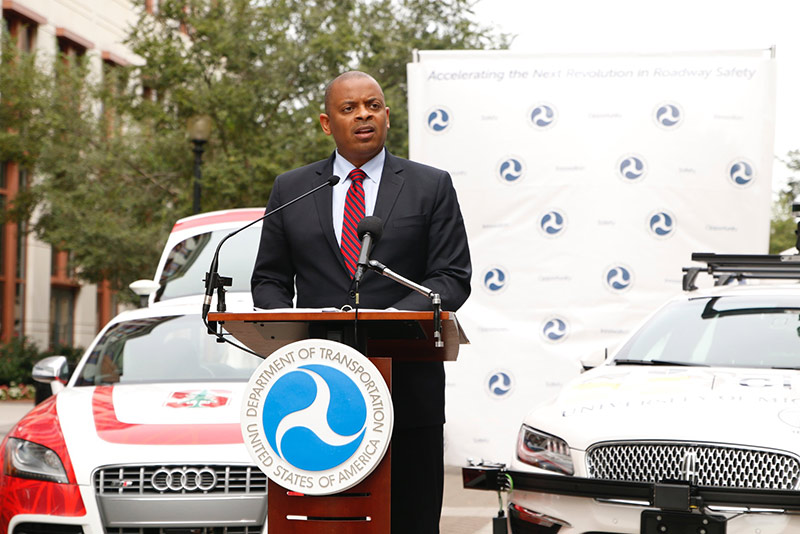
But in the Federal Automated Vehicles Policy document, Foxx said there was plenty of time for discussion with interested parties. "We expect vigorous input and welcome it," Foxx said.
A safety-first framework
Regulators from the Department of Transportation and the National Highway Traffic Safety Administration said the guidelines would foster technology that would reduce the frequency of fatalities and crashes on U.S. roads. More than 35,000 people died in roadway collisions in 2015, and 94 percent of the crashes "can be tied to a human choice or error," according to the Transportation Department.
The guidelines are designed to allow computers to take over many, and eventually all, of the driving functions in a vehicle. The rules apply to cars, trucks and commercial vehicles. The policy includes a 15-point safety assessment to guide the safe design, development, testing and deployment of automated vehicles.
Traffic safety regulators developed a five-level scale to assess vehicle automation, from Level 3 (where the automated system can conduct some parts of the driving task with a human driver behind the wheel to take over) to Level 5 (where the automated system can perform all driving tasks).
Industry support and concerns
The policy drew wide support from safety groups. "We have the same goal as NHTSA; we want to save lives," said Colleen Sheehey-Church, national president of Mothers Against Drunk Driving. Unlike humans, she noted, computers will never drive while intoxicated.
Some segments of the trucking industry also backed the initiative. "This kind of collaborative environment between the federal government, state and municipal entities and industry often leads to swift and safe adoption of technologies," said Jessica Nigro, a spokeswoman for Daimler Trucks, which has tested self-driving Freightliners in Nevada and autonomous trucks in Europe.
A wider coalition of manufacturers, transportation and technology companies also supported the policy. "This is an important step forward in establishing the basis of a national framework for the deployment of self-driving vehicles," said David Strickland, a former NHTSA administrator.
What it means for drivers
Spear said members of the trucking association are not rejecting technology and, in fact, are pushing forward researching and developing autonomous driving systems. Features such as adaptive cruise control and lane-assist technologies are already deployed in trucks, and the industry is testing platooning, where two or more trucks are connected digitally and drive in tight formation to save fuel.
"Some freight company leaders are predicting a day when professional truck drivers are more like pilots, heavily involved 'taking off' from the terminal and 'landing at the destination,' but engaging an auto-pilot on open stretches of highways," Spear wrote.
He cautioned that autonomous-vehicle technologies will have significant impacts on commercial freight companies, drivers and customers, as well as on safety and the environment. Hours-of-service rules, vehicle-to-vehicle communication, and specialized freight such as live animals and hazardous materials all need consideration. "Any policy framework that ignores these potential downstream impacts will be ill-informed," Spear said.
Move freight smarter with Doft
Thousands of loads, instant matching, and fast carrier pay — all in one place.
Sign up free