
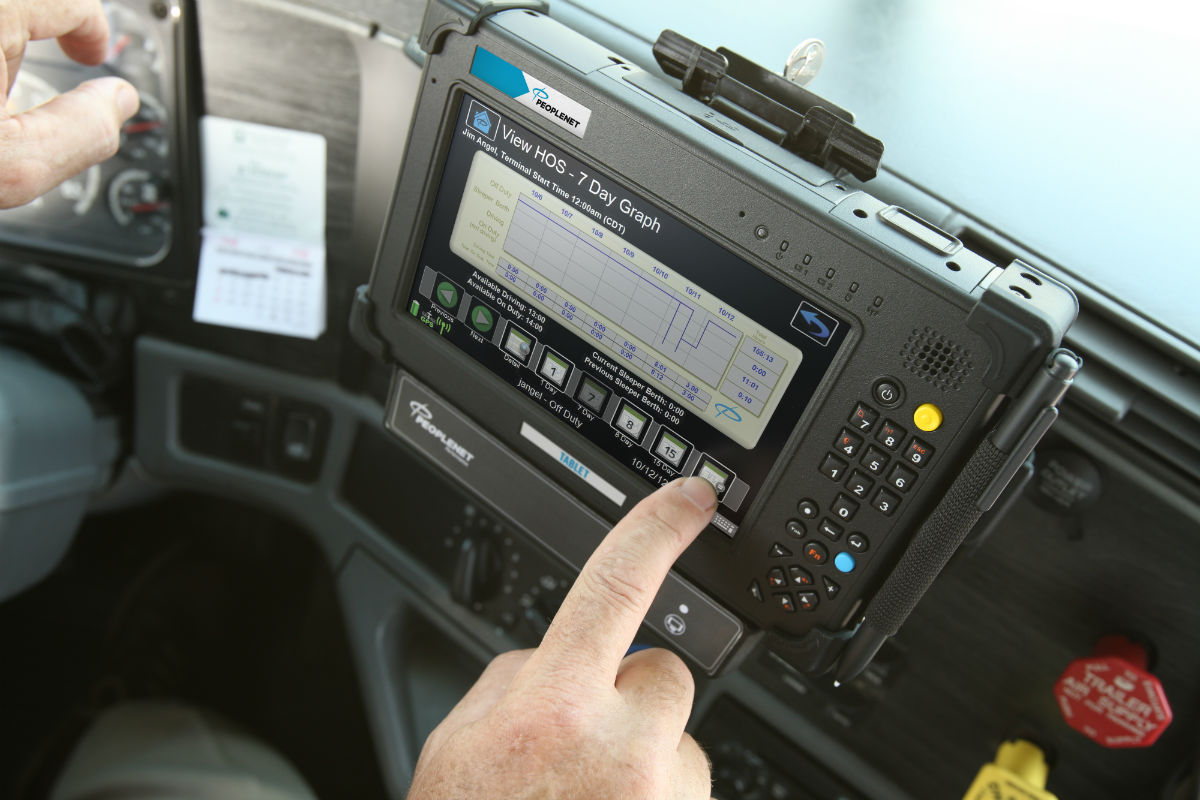
A panel of owner-operators and drivers at the Great American Trucking Show illustrated a shift noted by many carriers and drivers who've moved from paper logs to today's e-log platforms for hours-of-service recording.
The long-in-practice habit of "catching up the logbook" by drivers will mostly fall by the wayside. With no pencil to be pushed across paper, as long as the device is operational and open, duty-status changes happen with the simple push of a button in real time.
That seemingly simple change brings with it a raft of complications, from new administrative and operational burdens placed on drivers and carrier dispatch to the pressing need for shipper/receiver customers' appreciation of the new dynamics.
Customers Have to Change Expectations
Driver Bob Stanton, during the FMCSA panel, noted that before e-logs "getting the load there on time was the first priority." Before, "you made your log look legal after" that first priority was met. Now, if there's any chance you can't get the load there on time within the hours rules, you need to make the appropriate calculations and stay aware of the fact well beforehand.
"The customer has to change their expectation," Stanton said, advising drivers and carriers alike to get as firm as possible with them. Whenever delays put him behind schedule, where a reasonable expectation of load or unload times would cause him to exceed his on-duty maximum, "I document that I don't have legal hours and stop five minutes from my customer, and we move [the pick or drop] to the morning" or pursue another fix, such as a relay.
Live-Load and Unload Situations
Several attendees remarked on the uncertainty of detention timing around live-load/unload situations. Owner-operator Charles Alexander, leased to Landstar, takes a high-touch approach with customers: "I like to call and let them know I'm coming. I let them know what my hours are. I think they appreciate the fact that I let them know." He keeps communication lines open with the agent on the load and uses annotations within the e-log to create a record if there's an issue with hours.
No more "pinning everything on the driver," Alexander said. "I can show [the issues] on the ELD," which wasn't necessarily common practice on paper. "It can create a dispute" down the line about what happened in the event of a service failure "if I can't show it."
The Parking Problem
Owner-Operator Independent Drivers Association board member Johanne Couture emphasized parking as the "no. 1 problem in our industry." "I'm thinking about where I'm going to park tonight when I wake up, before I ever turn the wheel," Couture said. "Sometimes I can utilize spots at tank-wash facilities — my first choice."
Attendees asked what to do when a search for parking causes drivers to exceed daily driving or on-duty maximum limits. FMCSA enforcement division specialist LaTonya Mimms noted officers retain discretion on whether to write a violation. If the time over the limits is "no more than 15 minutes," the "trooper may or may not cite a nominal hours violation," with little consequence for safety scores. In excess of 15 minutes, a normal violation would be the go-to mark. Mimms and others emphasized use of annotations on any duty-status change to explain special circumstances.
Device Reliability
Couture also raised ELD device malfunction, noting that early on her device "malfunctioned three times" in a few weeks. "I'm a target for enforcement just because of what I haul. I want 100 percent reliability." Stanton's experience differed, but he emphasized the manufacturer matters: "Since 2010 I've had two malfunctions, yet the equipment is from a major manufacturer. Who you shop with will be a factor."
The takeaway for drivers and carriers: build buffer into your schedules, train your customers on the new realities of electronic logs, use annotations liberally, and choose reliable hardware.
Source: OverdriveOnline
Move freight smarter with Doft
Thousands of loads, instant matching, and fast carrier pay — all in one place.
Sign up free